
Most supply chain businesses have at least one system they’d love to replace but can’t afford to stop. It handles order management, warehouse movements, carrier bookings, customs declarations, or some combination of all four. It was built years ago, possibly by someone who no longer works there. It runs on infrastructure that no one fully understands. And it mostly works.
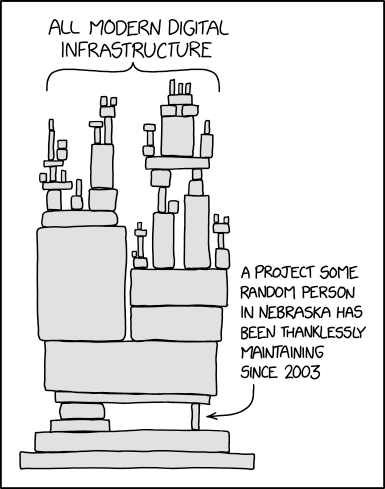
The problem isn’t that it breaks. The problem is everything around it: the workarounds, the manual processes that exist because the system can’t handle certain edge cases, the junior developer who spent three weeks reverse-engineering an undocumented API integration so they could make a small change without breaking something else.
This is the reality for a large proportion of supply chain operations. The core system is too critical to touch, too opaque to extend, and too expensive – in time, risk, and money – to replace using traditional methods. So it stays. And the technical debt compounds.
Rebuilding: the scorched earth approach
The conventional response to a system like this is a full rewrite: scope everything, build from scratch, run in parallel, cut over. It is also one of the most reliable ways to waste eighteen months and a significant budget before anything useful ships.
The failure mode is usually the same. The original system contains years of accumulated business logic, such as pricing rules, carrier-specific handling, and exception workflows, much of which was never formally documented. When you try to rebuild it, you discover that the new system doesn’t quite match the old one’s behaviour. Edge cases emerge. Users push back. The go-live date moves. Eventually the project either ships in a degraded state or gets quietly cancelled.
This happens to supply chain businesses of every size, and for a predictable reason: a rewrite treats the old system as something to discard, when it’s actually the most complete record of how the business works.
What AI-assisted modernisation actually looks like
If you’ve read enough headlines about AI coding, you’d be forgiven for thinking that its role here might be to make it quick and easy to rewrite the whole system, but the real value is that it makes it possible to take a different approach entirely.
Before any new code gets written, you need to understand what you’re dealing with. AI tools can read and document a legacy codebase in a fraction of the time it would take a human developer to do the same job. Not perfectly (the AI doesn’t understand the business context) but well enough to produce a map of what the system does, how the components relate to each other, and where the risks are. That documentation can then become the foundation for the modernisation work.
From there, the approach changes depending on what the system actually needs. Some components can be refactored rather than replaced. Others may be genuinely past their useful life and need rewriting, but now we can approach that with a clear specification to work from rather than a blank page. AI assists with generating code, but the decisions about architecture, sequencing, and risk stay with experienced engineers who understand the domain. That’s the difference between AI as a shortcut and AI as a tool in the hands of people who know what to do with it.
The result is a faster process at a lower cost than a traditional rebuild, and with a substantially lower risk of the project collapsing under its own weight.
What you keep
The practical concerns supply chain businesses raise when modernisation comes up usually boil down to: Who owns the code? Who controls where it’s deployed? What happens if the relationship with the development partner ends?
These are the right questions to ask.
At Logicc, the code we produce belongs to the client. Full source code ownership, no lock-in to our infrastructure or proprietary frameworks that only we can maintain. The architecture is designed so that another team could pick it up if needed. We also make sure the documentation produced during modernisation stays with the client, so you won’t be flying blind any more.
This matters particularly in supply chain, where systems often need to integrate with external parties: carriers, freight forwarders, customs platforms, third-party warehouse management systems. Those integrations represent years of accumulated knowledge about how those external systems actually behave in practice rather than how their documentation says they should behave. That knowledge needs to be captured and documented, not kept in someone’s head.
When to start
If your business is running on a system that’s limiting what you can do, it’s not a question of whether to modernise, but when (and how!). Waiting doesn’t make it cheaper. The technical debt compounds, the people who understand the old system gradually move on, and the distance between what the system does and what the business needs grows wider.
AI-assisted modernisation doesn’t remove the work. Updating a complex supply chain system is still a significant undertaking that requires proper planning, experienced engineers, and genuine understanding of the domain. What it does is make the work more tractable: faster to scope, faster to execute, and with a clearer picture of what you’re building towards before a line of new code is written.
If this describes a system you’re running, it’s worth talking through what modernisation would actually involve for your specific situation. We’ve been building and rebuilding supply chain systems for over twenty years. We know what these projects look like when they go well, and we know what causes them to go wrong.